
Why "Big Bang" Rewrites Fail
When dealing with a fragile legacy application (monolithic codebases written a decade ago with minimal documentation), the instinctive reaction of many engineering teams is to propose a complete, from-scratch rewrite.
In enterprise software, "big bang" rewrites suffer from high failure rates. While a separate team attempts to rebuild five to ten years of institutional business logic in a new stack, the live legacy system continues to evolve. Deadlines slip, costs balloon, and when the switchover finally happens, unforeseen edge cases cause critical operational disruptions.
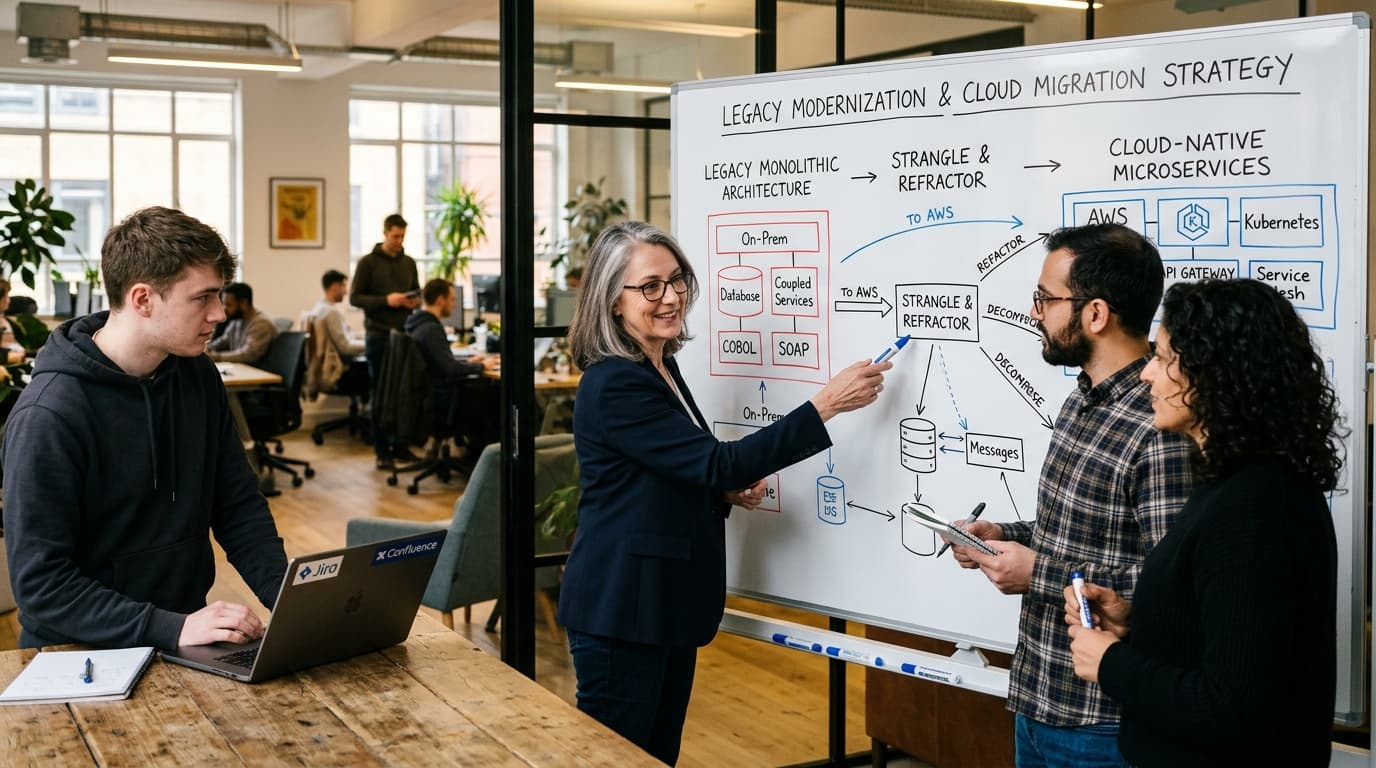
The Strangler Fig Pattern Explained
Named after Australian vines that gradually envelop and replace host trees, the Strangler Fig architectural pattern provides a proven blueprint for progressive modernization:
- Place an API Gateway / Reverse Proxy in front of the existing legacy application.
- All client traffic initially routes through the proxy directly to the legacy backend.
- Identify a single, self-contained business capability (e.g., Customer Authentication, Order Calculation, or Reporting).
- Implement that specific domain cleanly in the modern cloud architecture.
- Update the proxy to intercept routes for that specific capability and route them to the new service, leaving everything else untouched.
- Repeat iteratively until the legacy codebase has been safely decommissioned.
Step-by-Step Modernization Framework
- Phase 1: Observability & Test Encapsulation: Wrap critical legacy endpoints with automated integration tests and telemetry to capture baseline behavior.
- Phase 2: Anti-Corruption Layer (ACL): Build translation layers between old data schemas and modern domain models to prevent legacy quirks from polluting new code.
- Phase 3: Incremental Slice Extraction: Migrate the lowest-risk, highest-value modules first to validate the pipeline before tackling core ledger or transaction engines.
- Phase 4: Database Decoupling & Retirement: Migrate data stores gradually using change data capture (CDC) until the old database can be safely archived.
Bi-Directional Data Synchronization
During multi-month progressive migrations, the legacy system and the new platform must frequently co-exist and share real-time state.
Using event-driven Change Data Capture (CDC via tools like Debezium or cloud-native replication streams) ensures that writes to either system are immediately reflected in the other without requiring intrusive changes to old legacy code.
Maintaining Business Continuity
Progressive modernization shifts the narrative from high-risk capital expenditure to continuous, value-generating operational improvements. Each released module delivers immediate performance, security, and developer productivity benefits to the organization from month two onwards.