
The "Human Middleware" Crisis
As mid-market and enterprise businesses grow, they organically accumulate specialized SaaS tools: Salesforce or HubSpot for sales, NetSuite or SAP for finance, custom portals for customer service, and third-party logistics for fulfillment.
Without a deliberate systems integration architecture, employees become "human middleware", manually exporting CSVs, cross-referencing mismatched IDs, and copy-pasting customer records across five open browser tabs. This creates severe operational drag, data inaccuracies, and customer frustration.
Point-to-Point vs Event-Driven Integration
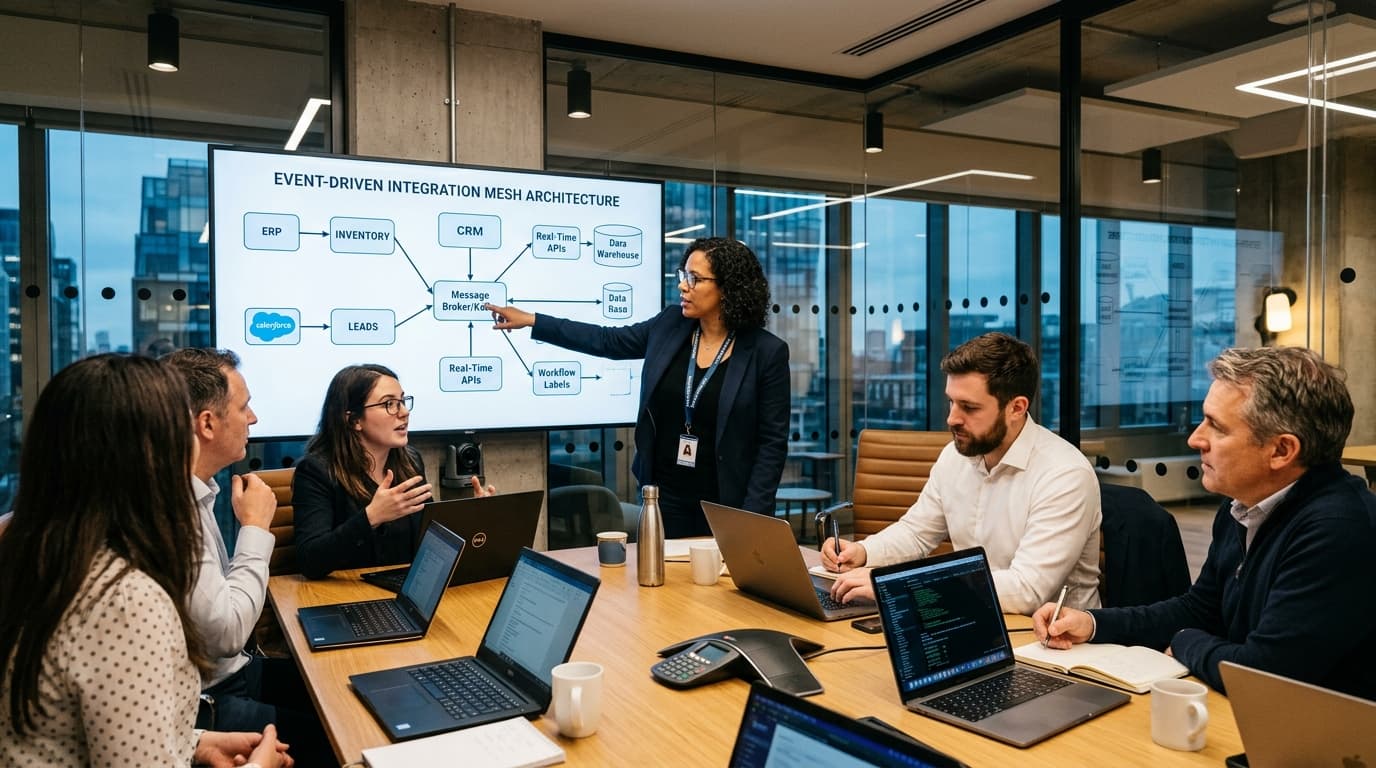
When businesses attempt to connect systems, they often begin with ad-hoc point-to-point webhook scripts. As the number of systems grows, this creates an unmaintainable "spaghetti" topology where changes to one API break five downstream processes.
The modern standard is an Event-Driven Integration Architecture:
- Systems publish domain events (e.g.,
OrderPlaced,CustomerUpdated,PaymentCaptured) to a centralized event bus. - Downstream subscribers consume events asynchronously at their own rate.
- Adding a new reporting or operational tool requires simply attaching a new listener without modifying core operational software.
Dead-Letter Queues and Idempotency
In the real world, third-party APIs experience downtime, rate limits, and network timeouts. Robust integration platforms must incorporate:
- Idempotent Consumers: Ensuring duplicate event deliveries never result in double billing or duplicate order creation.
- Dead-Letter Queues (DLQ): Failed messages are quarantined with full payload context and error logs for automatic or operator-guided retry.
- Rate-Limit Throttling: Token bucket algorithms that smooth out traffic spikes to stay within vendor API constraints.
A Pragmatic Integration Roadmap
Begin by identifying your single Master Record of Truth for core entities: Customers, Products, and Financial Orders. Establish unified unique identifiers across all databases and build event synchronization for that core triad first before automating secondary reporting workflows.